
By Afeen Wellness | Fitness & Exercise / Nov 2026
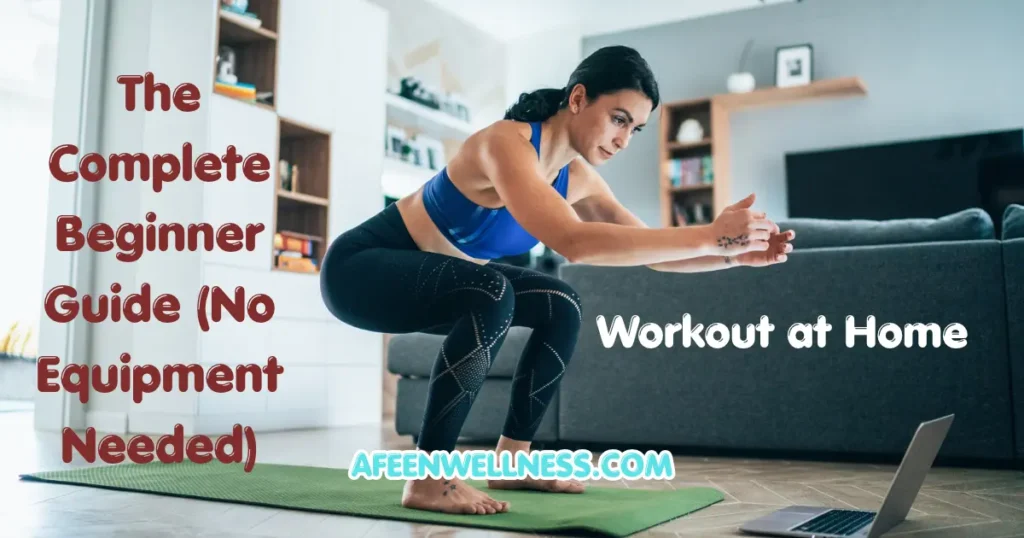
You don’t need a gym membership, a personal trainer or a garage full of machines to get fit. A workout at home can build strength, improve stamina and lift your mood, as long as you do it regularly and with good form. This guide shows you how to start a home workout without equipment, gives you a simple beginner workout plan, and explains how to stay safe and consistent.
Quick Summary
- A workout at home is free, flexible and beginner-friendly.
- Start with 3 to 4 sessions a week of 20 to 30 minutes.
- Focus on five basic movements: squat, push, pull or hinge, lunge and core.
- Warm up first, cool down after, and add difficulty slowly.
- Pair exercise with good sleep, water and balanced meals.
Why a Workout at Home Is Perfect for Beginners
Starting a fitness journey can feel intimidating. Many people believe they need expensive equipment, pricey memberships or expert supervision. They don’t. Here is why a beginner workout at home works so well.
1. It costs nothing
Squats, push-ups, lunges and planks need no machines. That makes fitness accessible to students, families and anyone on a tight budget, and it’s easy to keep up long term.
2. It saves time and energy
Travel, traffic, waiting for machines and packing a gym bag can turn a 30-minute session into 90 minutes. At home you can train right after waking up or before bed, and even 20 to 25 minutes counts.
3. It reduces gym anxiety
New exercisers often worry about being judged, not knowing how equipment works or comparing themselves with others. Training at home gives you a private space to learn at your own pace.
4. It builds a solid movement foundation
Bodyweight training teaches you to squat, push, pull, lunge and brace your core with control. This improves balance, coordination and joint stability before you ever pick up a heavy weight.
5. It makes consistency easier
Consistency beats intensity. A routine that is convenient, short and manageable is far easier to repeat every week than a punishing plan you dread.
6. It is flexible and builds self-discipline
There are no opening hours or class times. Morning, lunch break or evening, you choose. Showing up for yourself also builds discipline and time management that carry over into the rest of your life.
7. It is gentler for absolute beginners
Bodyweight exercises are naturally limited by your own strength, which lowers the risk of overloading muscles and joints while your body adapts.
Benefits of a Home Workout Without Equipment
Supports heart health
Moving at a moderate intensity, such as with jumping jacks, high knees or marching on the spot, raises your heart rate and strengthens your cardiovascular system over time. Regular activity is linked with better circulation, better endurance and lower risk of long-term heart disease.
Builds lean muscle and strength
Squats, lunges, push-ups, glute bridges and planks use your own body weight as resistance. For beginners, this is enough to stimulate muscle growth and noticeable strength gains. More muscle also means you use a little more energy even at rest.
Helps with weight management
Cardio moves burn calories, and strength moves build muscle that supports your metabolism. Combined with balanced nutrition, portion awareness, hydration and enough sleep, a home workout can support gradual, sustainable weight loss. Exercise alone rarely does the job, so food and sleep matter too.
Boosts mental health
Physical activity is linked with lower stress, better sleep, improved mood and greater self-confidence. Finishing even a short session gives you a sense of achievement that builds momentum.
Improves mobility and flexibility
Sitting for long periods can leave the hips, shoulders and lower back stiff. Squats, lunges, glute bridges, arm circles and stretching help keep joints moving and muscles supple.
Before You Start: Warm-Up (5 to 7 Minutes)
Never skip your warm-up. It increases blood flow, loosens joints and prepares your body for work. Try this:
- March on the spot: 1 minute
- Arm circles (forward and back): 1 minute
- Hip circles: 1 minute
- Bodyweight squats (easy pace): 10 reps
- Cat-cow stretch: 8 reps
- Gentle torso twists: 1 minute
Best Beginner Exercises for a Home Workout Without Equipment
These moves cover your whole body. Focus on slow, controlled form.
- Bodyweight squat (legs and glutes): sit your hips back, keep your chest up and knees tracking over your toes.
- Knee push-up (chest, shoulders, arms): keep a straight line from head to knees. Progress to full push-ups later.
- Reverse lunge (legs and balance): step back, lower with control, push through the front heel.
- Glute bridge (glutes, hamstrings, lower back): squeeze your glutes at the top.
- Plank (core): hold your body in a straight line, hips neither sagging nor piked.
- Superman hold (back): lie face down and lift your arms and legs a few centimetres.
- Jumping jacks or step jacks (cardio): choose the low-impact step version if jumping feels uncomfortable.
Beginner Workout Plan: 4-Week Schedule
This beginner workout plan uses three or four sessions a week with rest days in between. Do each exercise for the listed reps (or seconds for planks), rest 45 to 60 seconds between rounds, and complete the number of rounds shown.
| Week | Sessions per week | Rounds | Reps per exercise | Plank hold |
| 1 | 3 | 2 | 8 to 10 | 15 to 20 sec |
| 2 | 3 | 2 to 3 | 10 to 12 | 20 to 30 sec |
| 3 | 4 | 3 | 10 to 12 | 30 sec |
| 4 | 4 | 3 | 12 to 15 | 30 to 40 sec |
Sample session: squats, knee push-ups, reverse lunges (each leg), glute bridges, plank, superman hold. Finish with 2 minutes of step jacks.
Cool-down (5 minutes): hamstring stretch, quad stretch, child’s pose and chest stretch, holding each for 20 to 30 seconds.
HIIT Workout at Home for Beginners
High-intensity interval training (HIIT) alternates short bursts of effort with rest, so you can get a hard workout in a short time. A HIIT workout at home needs no equipment, but beginners should start gently.
Beginner HIIT (15 minutes):
- Work for 30 seconds, rest for 30 seconds
- Exercises: high knees, squats, mountain climbers (slow pace), step jacks, reverse lunges
- Go through the circuit 3 times, resting 1 minute between rounds
Do HIIT only 1 to 2 times a week at first, and swap high-impact moves for low-impact versions if you have sore knees or joints.
Best Group Exercises at Home
Exercising with other people keeps you motivated. Some of the best group exercises at home are simple:
- Partner circuit: one person does 40 seconds of an exercise while the other rests, then swap.
- Family challenge: everyone does the same number of squats, lunges and jumping jacks, and you beat your total each week.
- Follow-along video session: put on a beginner video and train together, in the same room or over a video call.
- Tabata with friends: 20 seconds on, 10 seconds off, across 4 exercises.
- Walk and stretch: a brisk family walk followed by a 10-minute stretch routine.
Want More Resistance? 30-Minute Full-Body Dumbbell Workout at Home
Once bodyweight moves feel easy, you can add resistance. You don’t need to buy dumbbells straight away. Water bottles, filled backpacks or tins work as light weights. If you do own dumbbells, try this 30-minute full-body dumbbell workout:
- Warm up for 5 minutes.
- Goblet squat: 3 sets of 10
- Dumbbell bent-over row: 3 sets of 10
- Dumbbell floor press: 3 sets of 10
- Dumbbell reverse lunge: 3 sets of 8 per leg
- Romanian deadlift: 3 sets of 10
- Shoulder press: 3 sets of 10
- Plank: 3 sets of 30 seconds
- Cool down for 5 minutes.
Choose a weight that lets you finish every rep with good form but feels challenging by the last two.
Common Mistakes to Avoid
Skipping the warm-up
Cold muscles are stiffer and more prone to strains. Five to seven minutes of gentle movement is a small investment that protects you.
Doing too much too soon
Exercising every day, adding advanced variations or pushing through pain often leads to soreness, fatigue and burnout. Start with 3 to 4 sessions a week and let your body recover.
Poor form
Without a mirror or coach, it’s easy to let your knees cave in, your hips sag or your back round. Slow down, use a mirror or record a short clip of yourself, and prioritise quality over quantity.
Not being consistent
Most people quit because results don’t come fast. Strength, stamina and body shape improve gradually. Missing a day is fine. Just get back to it the next day.
Ignoring nutrition and sleep
Protein supports muscle repair, carbohydrates fuel your workouts, healthy fats support hormone function and water keeps you hydrated. Sleep is when your body recovers. Exercise works best as part of a whole routine.
How to Stay Fit at Home: Simple Habits
- Schedule your workout like an appointment and keep it at the same time each day.
- Set up a small, tidy space so you can start in seconds.
- Track sessions on a calendar and reward weekly streaks.
- Add a daily walk and short movement breaks if you sit for long periods.
- Increase difficulty slowly, adding a few reps or one more round every week or two.
- Pick exercises you enjoy, since you’ll keep doing them.
Is a Home Workout as Good as the Gym?
For beginners looking for general fitness, strength and weight management, a well-planned workout at home can be very effective. Results depend far more on consistency, technique, gradual progression, nutrition and sleep than on location. Gyms do offer heavier weights and more variety, which can help advanced lifters, but most beginners don’t need these in the early months. The workout you can do regularly is the best one for you.
Frequently Asked Questions (FAQs)
What is the best exercise for beginners?
There isn’t a single best exercise. The best routine combines a few basics: squats for the legs, push-ups for the upper body, a plank for the core, lunges for balance and a bit of cardio such as brisk walking. Together these train your whole body and are easy to progress.
How do I stay fit at home?
Exercise 3 to 4 times a week, move regularly during the day, eat balanced meals, drink enough water and sleep well. A short, consistent routine you enjoy works better than occasional long, exhausting sessions.
Can I lose weight with a home workout without equipment?
Yes, it can support weight loss, especially alongside balanced eating and enough sleep. Weight loss comes from the overall balance of your lifestyle, and results vary from person to person.
How often should a beginner work out at home?
Aim for 3 to 4 sessions a week of 20 to 30 minutes, with rest days between. As your fitness improves, you can add sessions or make exercises harder.
How long does it take to see results?
Many people notice more energy and better mood within a couple of weeks. Strength and stamina improvements commonly show up over four to eight weeks of consistent training, though everyone progresses at a different pace.
Is HIIT safe for beginners?
Beginners can try HIIT in a modified, low-impact form with longer rest periods. Start with one or two short sessions a week and stop if you feel dizzy, unwell or sharp pain. If you have a heart or joint condition, speak with your doctor first.
How much exercise do adults need each week?
The World Health Organization recommends at least 150 to 300 minutes of moderate-intensity activity a week for adults, plus muscle-strengthening activities on two or more days. If that sounds like a lot, build up gradually from where you are.
Do I need dumbbells to build muscle at home?
No. Beginners can build strength with bodyweight exercises. Once those get easy, you can add dumbbells, resistance bands or household items such as filled water bottles.
The Bottom Line
A beginner workout at home with no equipment is a practical, affordable and sustainable way to improve your fitness. It removes the usual barriers of cost, travel and gym nerves, and it builds strength, stamina and confidence. Start small, focus on good form, stay consistent and increase difficulty gradually. Combine your workouts with healthy meals and quality sleep, and you’ll build a strong base for lifelong health.
Medical Disclaimer
The information in this article is provided for general educational purposes only and is not medical advice. It is not a substitute for professional diagnosis, treatment or guidance from a qualified healthcare provider. Consult your doctor before starting any new exercise programme, especially if you have a heart condition, high blood pressure, joint or back problems, are pregnant, are recovering from injury or illness, or have not exercised in a long time. Stop exercising immediately and seek medical help if you feel chest pain, dizziness, severe shortness of breath or sharp pain. Individual results vary. Afeen Wellness is not responsible for any injury or loss resulting from the use of this information.
Trusted Sources and Further Reading
- World Health Organization: Physical activity fact sheet
- Centers for Disease Control and Prevention (CDC): Physical activity guidelines for adults
- NHS: Exercise and physical activity guidelines
- Mayo Clinic: Fitness basics and exercise tips
- American Heart Association: Physical activity recommendations